


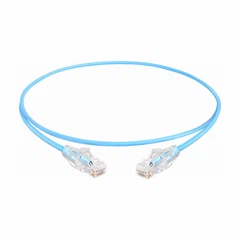


Hey there! As an Ethernet cables supplier, I often get asked about the differences between Cat5e and Cat6 Ethernet cables. It's a common question, especially for those who are setting up a home or office network. So, let's dive right in and break down the key differences.
1. Bandwidth
One of the most significant differences between Cat5e and Cat6 cables lies in their bandwidth capabilities. Bandwidth refers to the amount of data that can be transmitted over the cable in a given amount of time, usually measured in megahertz (MHz).
Cat5e cables are designed to support a bandwidth of up to 1000 Mbps (1 Gigabit per second) at a frequency of 100 MHz. This is sufficient for most home networks, where the demand for data transmission is relatively low. You can easily stream high - definition videos, browse the web, and play online games without any major issues.
On the other hand, Cat6 cables offer a much higher bandwidth. They can handle up to 10 Gigabit per second (10,000 Mbps) at a frequency of 250 MHz. This makes them ideal for high - performance networks, such as those in large offices, data centers, or homes with multiple smart devices and high - speed internet connections. If you're running servers, doing large file transfers, or using bandwidth - intensive applications, Cat6 cables will give you a much smoother experience.
2. Cable Construction
The construction of the cables also plays a crucial role in their performance.


Cat5e cables typically have four pairs of twisted copper wires. The twisting of the wires helps to reduce electromagnetic interference (EMI) and crosstalk, which are the main factors that can degrade the signal quality. However, the level of twisting in Cat5e cables is not as tight as in Cat6 cables.
Cat6 cables, in addition to having four pairs of twisted copper wires, often come with a spline or a separator between the wire pairs. This extra feature further reduces crosstalk and EMI, allowing for more reliable and faster data transmission. The tighter twists and the separator make Cat6 cables more robust and better able to handle high - speed data signals.
3. Distance Limitations
Distance is another factor to consider when choosing between Cat5e and Cat6 cables.
For Cat5e cables, the maximum recommended distance for a Gigabit Ethernet connection is 100 meters (about 328 feet). Beyond this distance, the signal strength may start to degrade, leading to slower data transfer speeds or even connection issues.
Cat6 cables also have a maximum recommended distance of 100 meters for a 1 Gigabit per second connection. However, when it comes to a 10 Gigabit per second connection, the maximum distance is reduced to 55 meters (about 180 feet). This is because the higher - speed signals are more susceptible to attenuation (signal loss) over longer distances.
4. Cost
Cost is always a consideration when making a purchasing decision.
Generally, Cat5e cables are more affordable than Cat6 cables. This is because they have less complex construction and lower performance capabilities. If you have a budget - conscious project or a home network with relatively low data requirements, Cat5e cables can be a great option.
Cat6 cables, due to their higher performance and better construction, are more expensive. However, if you're building a network that needs to support high - speed data transfer over the long term, the extra cost is often worth it.
5. Compatibility
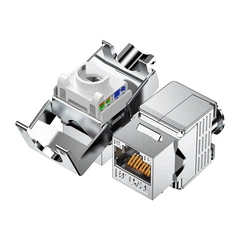
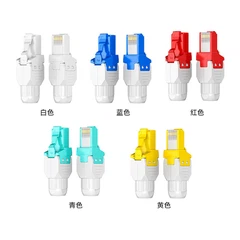
Both Cat5e and Cat6 cables use the same RJ - 45 connectors, which means they are physically compatible with most Ethernet devices, including routers, switches, computers, and gaming consoles.
However, it's important to note that the performance of your network will be limited by the lowest - performing component. For example, if you have a Cat6 cable connected to a device that only supports Gigabit Ethernet (like a Cat5e - compatible router), you won't be able to take advantage of the full 10 Gigabit per second speed of the Cat6 cable.
6. Future - Proofing
When setting up a network, it's always a good idea to think about the future. Technology is constantly evolving, and your network needs may change over time.
Cat5e cables are a good option for short - term or low - demand networks. But if you anticipate that your network will need to support higher data speeds in the future, such as for 4K video streaming, virtual reality, or large - scale data storage, Cat6 cables are a better choice. They offer more headroom for growth and can handle the increased data traffic that comes with new technologies.
7. Other Ethernet Cable Categories
It's also worth mentioning some other Ethernet cable categories. For example, the Category 3 Cable is an older type of cable that was commonly used for telephone lines and early Ethernet networks. It has a much lower bandwidth compared to Cat5e and Cat6 cables and is not suitable for high - speed data transfer.
On the other end of the spectrum, the Category 6 Augmented Cable offers even higher performance than standard Cat6 cables, with a bandwidth of up to 10 Gigabit per second over a 100 - meter distance. And the Category 8 Cable is designed for extremely high - speed data centers, with a bandwidth of up to 40 Gigabit per second over shorter distances.
Conclusion
In conclusion, the choice between Cat5e and Cat6 Ethernet cables depends on your specific needs. If you have a small home network with basic internet usage, Cat5e cables are a cost - effective option. But if you're running a high - performance network or need to future - proof your setup, Cat6 cables are the way to go.
As an Ethernet cables supplier, I can help you choose the right cable for your project. Whether you're a small business owner, a home user, or a large enterprise, I have the expertise and the products to meet your networking needs. If you're interested in purchasing Ethernet cables or have any questions, feel free to reach out and start a conversation about your procurement requirements. Let's work together to build a reliable and high - speed network!
References
- Ethernet Cable Standards and Specifications, Institute of Electrical and Electronics Engineers (IEEE)
- Network Cabling Best Practices, Telecommunications Industry Association (TIA)