


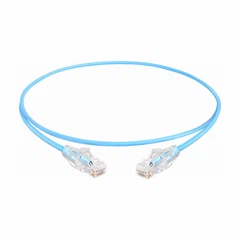


Yo, I'm an Ethernet cables supplier, and today I wanna chat about something that might seem small but can have a big impact on your network: the impact of cable bending on Ethernet performance.
Let's start with the basics. Ethernet cables are the unsung heroes of our digital lives. They're what connect our devices to the internet, allowing us to stream movies, play games online, and work remotely. But did you know that how you handle these cables can affect how well they work?
How Ethernet Cables Work
Before we dive into the effects of cable bending, let's understand a bit about how Ethernet cables function. Inside an Ethernet cable, there are multiple twisted pairs of copper wires. These twists are designed to reduce electromagnetic interference (EMI) between the wires. When data is sent through the cable, it travels as electrical signals along these copper conductors.
The performance of an Ethernet cable is measured by several factors, including bandwidth, signal attenuation (loss of signal strength), and crosstalk (interference between different wire pairs). Different categories of cables are rated for different levels of performance. For example, Category 6 Cable can handle higher bandwidths compared to Category 5 Enhanced Cable, and Category 3 Cable is even more limited in terms of speed and performance.
The Problem with Cable Bending
Now, let's talk about bending. When you bend an Ethernet cable, you're essentially changing the physical structure of those twisted wire pairs inside. This can lead to a few issues.
First off, bending can cause the twists in the wire pairs to loosen. Remember, those twists are there to reduce EMI. When they get loose, the cable becomes more susceptible to interference from external sources, like other electrical devices or even other cables nearby. This interference can lead to signal degradation, which means the data being sent through the cable might not arrive at its destination correctly.
Secondly, bending can increase signal attenuation. As the cable is bent, the path that the electrical signals need to travel becomes longer and more complex. This causes the signals to lose strength more quickly, especially at higher frequencies. So, if you're trying to achieve high-speed data transfer, a bent cable can really slow you down.
Another problem is crosstalk. When the wire pairs inside the cable are bent, they can get closer to each other, increasing the chances of interference between them. This can cause errors in the data transmission, leading to slower speeds and a less reliable connection.
Different Degrees of Bending
Not all bends are created equal. A slight bend in the cable might not have a significant impact on performance. But if you make a sharp bend, like a 90-degree angle or even a tighter loop, that's when you're really asking for trouble.


For example, if you're running an Ethernet cable along a wall and you need to make a turn, it's better to make a gentle curve rather than a sharp corner. A sharp bend can cause the cable to kink, which is a severe form of bending that can permanently damage the internal structure of the cable.
Real - World Impact
In a home network, a bent cable might just cause occasional slowdowns or dropped connections. You might notice that your Wi - Fi seems a bit spotty, even though your router is working fine. It could be that the Ethernet cable connecting your router to your modem is bent or kinked.
In a business or data center environment, the impact can be much more serious. Slow or unreliable network connections can lead to lost productivity, missed deadlines, and even financial losses. For example, in a large office building, if the Ethernet cables connecting different departments are bent or damaged, it can disrupt communication and data sharing between teams.
Preventing Bending Issues
As an Ethernet cables supplier, I've got some tips on how to prevent these bending problems.
First, when you're installing the cables, make sure you have enough slack to avoid sharp bends. Plan your cable routes carefully, and use cable management tools like cable ties and raceways to keep the cables organized and prevent them from getting bent accidentally.
Second, be careful when moving or rearranging furniture or equipment that might be near the cables. A sudden jolt or tug on the cable can cause it to bend or kink.
Finally, if you suspect that a cable is bent or damaged, it's a good idea to replace it. It's a relatively inexpensive fix compared to the potential problems that a bent cable can cause.
Conclusion
In conclusion, cable bending can have a significant impact on Ethernet performance. Whether you're using Category 6 Cable for high - speed applications or Category 3 Cable for more basic needs, taking care of your cables is essential for a reliable network.
If you're in the market for Ethernet cables, we've got a wide range of options to suit your needs. Whether you need cables for your home network, a small business, or a large data center, we've got you covered. Don't hesitate to reach out for a chat about your requirements and how we can help you get the best performance out of your Ethernet setup.
References
- "Ethernet Cabling: A Comprehensive Guide" by some networking expert
- Industry whitepapers on Ethernet cable performance and installation best practices