



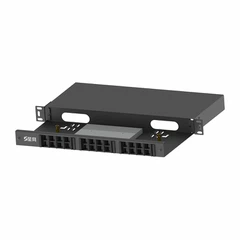

In the realm of network infrastructure, fiber optic network patch panels play a crucial role in ensuring efficient and reliable data transmission. As a leading network patch panel supplier, I often encounter questions from customers regarding the differences between single - mode and multi - mode fiber optic network patch panels. In this blog, I will delve into the key distinctions between these two types of patch panels to help you make an informed decision for your network needs.
1. Basic Principles of Single - mode and Multi - mode Fiber Optics
Before we discuss the patch panels, it's essential to understand the underlying principles of single - mode and multi - mode fiber optics.
Single - mode fiber (SMF) is designed to carry a single ray of light, or mode, along the fiber core. The core diameter of single - mode fiber is typically around 9 microns, which is extremely small. This small core size allows for a more direct and less dispersed transmission of light, resulting in very low signal loss over long distances. Single - mode fiber is ideal for long - haul telecommunications, data centers with large - scale connections, and high - speed, long - distance network applications.
On the other hand, multi - mode fiber (MMF) can carry multiple rays of light, or modes, simultaneously. The core diameter of multi - mode fiber is much larger, usually 50 or 62.5 microns. Due to the larger core, multi - mode fiber is easier to couple light into and is more cost - effective for short - to medium - distance applications. However, the multiple modes can cause signal dispersion, which limits the transmission distance and data rate compared to single - mode fiber.
2. Physical Characteristics of Single - mode and Multi - mode Patch Panels
Connector Types
Single - mode patch panels commonly use connectors such as the LC (Lucent Connector) and SC (Subscriber Connector). These connectors are designed to provide a precise alignment of the single - mode fiber cores, minimizing signal loss. The LC connector, in particular, is popular in high - density applications due to its small size.
Multi - mode patch panels also use LC and SC connectors, but they are often paired with multi - mode fibers. Additionally, the MPO (Multi - Fiber Push On) connector is widely used in multi - mode networks, especially in data centers where high - density connections are required. The MPO connector can house multiple fibers in a single connector, allowing for quick and easy installation.
Panel Design
Single - mode patch panels are often designed with a focus on minimizing signal loss and maintaining high - quality transmission. They may have features such as dust caps to protect the connectors from contamination and precise fiber management systems to ensure proper routing of the fibers.
Multi - mode patch panels, on the other hand, are designed to accommodate the larger core size of multi - mode fibers. They may have more space for fiber bending and routing, as multi - mode fibers are generally more flexible than single - mode fibers.
3. Performance Differences
Bandwidth and Data Rate
Single - mode fiber patch panels support extremely high bandwidth and data rates. They can transmit data at speeds of up to 100 Gbps or even higher over long distances. This makes them suitable for applications that require high - speed data transfer, such as large - scale data centers and long - distance telecommunications networks.
Multi - mode fiber patch panels have a more limited bandwidth and data rate compared to single - mode. While they can support data rates of up to 10 Gbps or 40 Gbps over short distances, the signal dispersion in multi - mode fibers restricts the achievable data rate and transmission distance.
Transmission Distance
Single - mode fiber patch panels are capable of transmitting data over very long distances, often up to several kilometers or even tens of kilometers without the need for signal amplification. This is due to the low signal loss and minimal dispersion in single - mode fibers.


Multi - mode fiber patch panels are typically used for short - to medium - distance applications, usually up to a few hundred meters. The signal dispersion in multi - mode fibers increases with distance, which limits the transmission range.
4. Cost Considerations
Fiber Cost
Single - mode fiber is generally more expensive than multi - mode fiber. The manufacturing process for single - mode fiber is more complex, and the smaller core size requires more precise manufacturing techniques. Additionally, single - mode connectors are often more expensive due to their high - precision requirements.
Multi - mode fiber is more cost - effective, especially for short - distance applications. The larger core size makes it easier to manufacture, and the connectors are also relatively less expensive.
Installation and Maintenance Cost
The installation of single - mode fiber patch panels requires more expertise and precision. The alignment of single - mode fibers is critical to ensure low signal loss, which may result in higher installation costs. Maintenance of single - mode fiber networks also requires specialized equipment and trained technicians.
Multi - mode fiber patch panels are easier to install and maintain. The larger core size makes it more forgiving in terms of alignment, and the installation process is generally less complex. This results in lower installation and maintenance costs.
5. Application Scenarios
Single - mode Patch Panels
Single - mode patch panels are commonly used in long - distance telecommunications networks, such as those used by telephone companies and internet service providers. They are also essential in large - scale data centers that require high - speed, long - distance connections between servers, storage systems, and network switches.
Multi - mode Patch Panels
Multi - mode patch panels are widely used in local area networks (LANs), such as those in offices, schools, and small - to medium - sized data centers. They are suitable for short - distance applications where high - speed data transfer is required within a limited area.
6. Related Products in Our Catalog
As a network patch panel supplier, we offer a wide range of products to meet different customer needs. If you are interested in other types of patch panels, you can check out our Category 5e Patch Panel, Category 3 Patch Panel, and Blank Patch Panel. These products are designed to provide reliable and efficient network connectivity.
7. Conclusion and Call to Action
In conclusion, the choice between single - mode and multi - mode fiber optic network patch panels depends on your specific network requirements, including transmission distance, data rate, and budget. Single - mode patch panels are ideal for long - distance, high - speed applications, while multi - mode patch panels are more suitable for short - to medium - distance applications.
If you are in the process of building or upgrading your network infrastructure, and you need professional advice on choosing the right patch panel, or if you have any questions about our products, please feel free to contact us. We are committed to providing high - quality products and excellent customer service to help you achieve a reliable and efficient network.
References
- “Fiber Optic Communication Systems,” by Govind P. Agrawal.
- “Network Cabling Installation and Troubleshooting,” by Mark Ciampa.